
Architectural Icons of the Modern Era: What Ontario Can Learn from the 1980s & 1990s
Ontario is a province full of innovation, cultural depth, and architectural talent. Yet, despite being home to leading firms, its built environment often fails to reflect that creativity. Across the province, from Toronto to smaller towns, the repetition of bland towers and plazas shows the need for a new approach.
Despite being home to some of Canada’s leading firms in architecture Ontario, our urban and suburban landscapes often fail to reflect the creative energy of our communities. To move forward, we must first look back—especially to the 1980s and 1990s, when architectural design in Ontario was fearless, contextual, and expressive.

When Ontario Built with Vision: The Modern Design Legacy
The late 20th century was a period of experimentation and ambition in Ontario’s architectural evolution. Projects weren’t just designed to meet code—they were designed to say something.
The SkyDome (now Rogers Centre), completed in 1989, remains a symbol of Ontario’s forward- thinking design. With the world’s first fully retractable roof and a bold approach to urban integration, it showed that architectural design Ontario could stand on the global stage. Internationally, this same era gave us icons like Tadao Ando’s Church of the Light and Richard Meier’s High Museum of Art—examples of design rooted in purpose, minimalism, and experience. This was a time when creative architecture wasn’t the exception; rather, it was the expectation. Moreover, buildings carried meaning and ambition.
Ontario’s Current Challenge: Design Fatigue
Today, Ontario’s new developments often lean into sameness. Consequently, from condo towers in downtown Toronto to suburban malls, we see copy-paste architecture replacing identity-driven design.
As Christopher Hume noted:
“When you wander the downtowns of Toronto, Calgary, and Vancouver, it’s hard to tell one tower from another.”
This isn’t just a visual problem—it’s a design culture problem. When buildings are treated as financial instruments instead of community assets, architecture becomes shallow, transactional, and forgettable. That mindset holds us back across Ontario. And it’s time to break the cycle.
A Different Approach: Holland Landing Commercial Centre
We believe Ontario’s architectural future must be defined by design that is site-specific, deliberate, and meaningful—not standardized solutions.
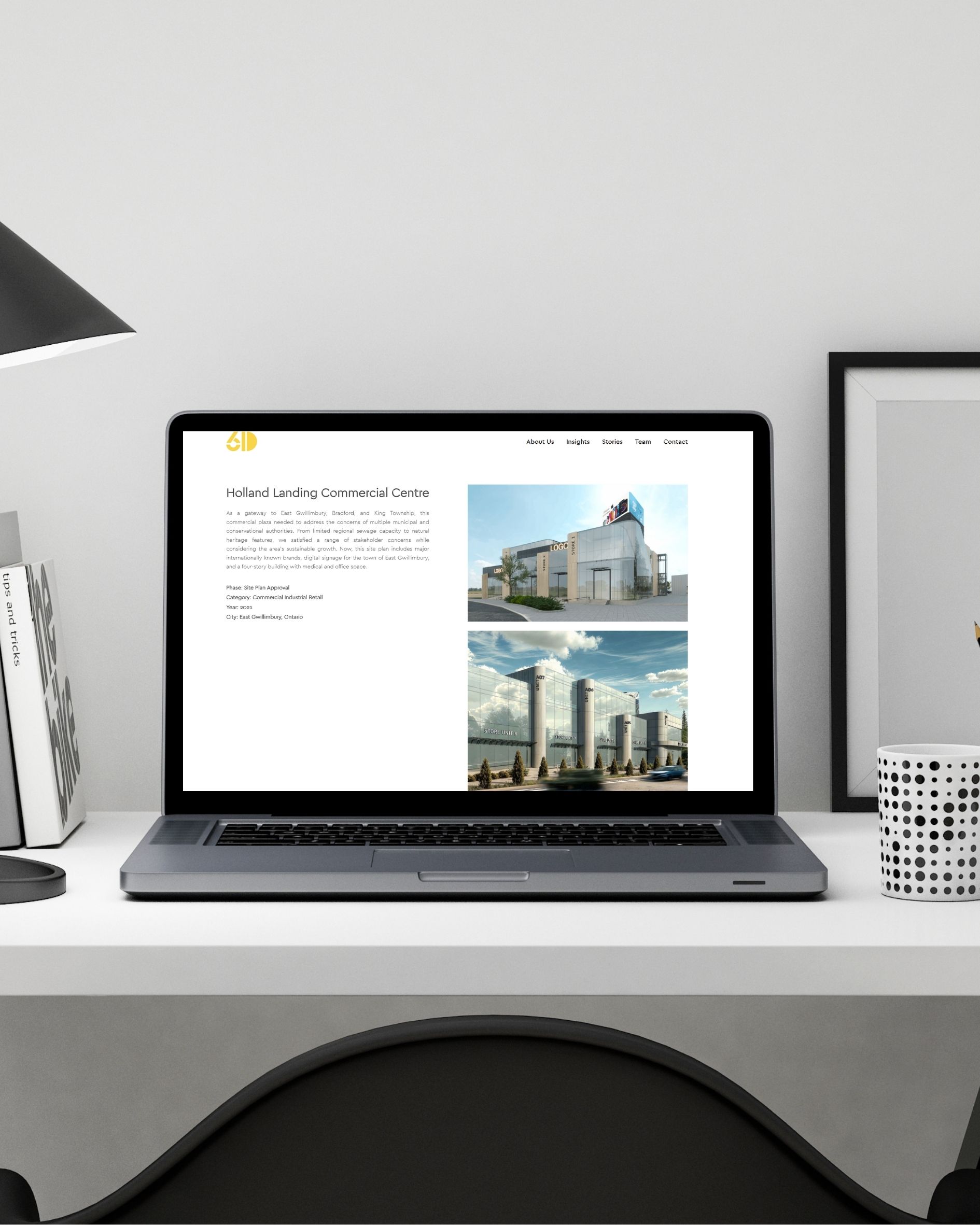
Our Holland Landing Commercial Centre is a strong example. This development responds to a unique context and real community needs. It was never about checking boxes—it was about building something that mattered.
The site presented constraints including limited sewage capacity, environmental regulations, and the absence of key services. Nevertheless, instead of scaling back, we doubled down on quality. Our site plan delivers:
• National anchor tenants that ensure long-term viability
• A four-storey building with medical and professional office space
• Digital signage as a communication point for the Town of East Gwillimbury
• A walkable, high-exposure layout that blends commercial function with civic value
Unlike the many strip plazas across Southern Ontario, this project is designed to be a gateway—an active, inclusive, and high-performance development that raises the standard for urban design Ontario.
What Ontario Architecture Needs Now
Across the province, a shift is needed—one that places design integrity at the core of development.
Here’s how Ontario can lead with architecture again:
• Empower Ontario architects to innovate, not just execute.
• Design for people first. In addition, prioritize community life, wellness, and long-term use.
• Reject the generic. Create buildings that reflect local culture, climate, and history.
• Reimagine the suburban model. Think beyond single-use zoning and shallow commercial formulas.
• Build with future generations in mind. Integrate sustainability, flexibility, and resilience into every project.
As Craig Applegath of DIALOG puts it:
“What we do has a direct impact on people’s lives. We still have to plan for the future even though we don’t know what it will be.”
The most responsible form of architectural design in Ontario is one that embraces the unknown—and responds to it with imagination and intent.
Designing with Purpose Across Ontario
Whether working on mixed-use plazas, multiplex housing, or institutional design, we see architecture as a tool for meaningful change.
At 6ixDesign, we’re committed to creating spaces that serve people, express identity, and reflect the evolution of Ontario’s built form. The Holland Landing Commercial Centre is one of many steps in that direction—toward a province that values smart growth, inclusive design, and creative risk-taking.
Because “just good enough” shouldn’t be the design standard in Ontario.